
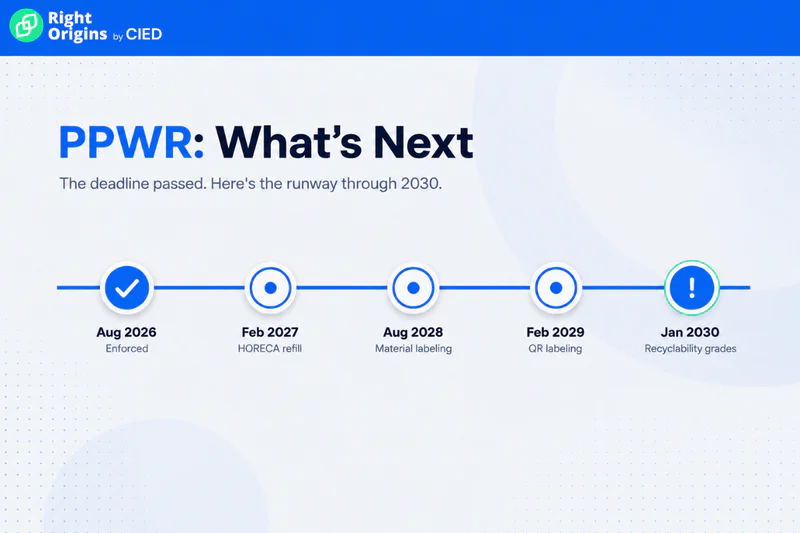
August 12, 2026 came and went. If your packaging compliance program was fully ready, you're ahead of most of the market, the European Commission's own guidance, issued just days before the deadline, acknowledged that "industry has raised a significant number of implementation questions" that remained unresolved at enforcement. If you're not fully ready, you're not alone, and the more useful question now isn't "did we make it," it's "what's actually enforceable today, what's our real exposure, and what's next."
This is a reality-check guide, not a pre-deadline checklist - those are everywhere already. Here's what changed on August 12, what to do if you have gaps, and the full runway of deadlines still ahead through 2030 and beyond.
What actually became mandatory on August 12, 2026
Four obligations went live with no grace period, and they apply broadly across manufacturers, importers, distributors, and producers:
PFAS and heavy metals restrictions. Food-contact packaging is now capped at 25 ppb for individual PFAS, 250 ppb total PFAS, and 50 ppm total fluorine. All packaging types are restricted to a combined 100 mg/kg for lead, cadmium, mercury, and hexavalent chromium.
EU Declaration of Conformity (DoC). Manufacturers must issue a formal self-declaration for every packaging type, using the Annex VIII model, confirming compliance with Articles 5-12. Importers must collect and retain these for 5-10 years.
Identification and contact labeling. Every packaging unit needs a traceable identifier (type, batch, serial number) plus manufacturer name, trademark, and postal address — directly on the packaging or via QR code/accompanying documents.
EPR registration. Producers must be registered with national Extended Producer Responsibility systems in every EU member state where their packaged goods are sold.
If you're a company already using reusable packaging systems, you also need active collection, reconditioning, and redistribution infrastructure running today, not just planned.
The gap we'd expect most food & ingredient manufacturers still have

Based on how this regulation actually gets implemented in practice, three gaps are the most common right now:
Declaration of Conformity coverage holes. Companies with dozens or hundreds of SKUs across multiple co-packers and private-label lines frequently have DoCs for their flagship products but gaps across the long tail — especially anything sourced through a distributor rather than a direct manufacturer relationship.
EPR registration lag in secondary markets. Teams register in their primary sales markets first and treat smaller EU markets as "we'll get to it" — which is a real enforcement exposure the moment a regulator in that market checks.
PFAS/heavy metals documentation without lab verification. A supplier attestation that packaging is "PFAS-free" is not the same as a validated Certificate of Analysis confirming it against the 25/250 ppb thresholds. Regulators and retail customers alike are starting to ask for the underlying test data, not just the attestation.
If any of these sound familiar, the practical fix is the same one that applies to every other supplier-data compliance program: centralize the documentation requests, track completion by SKU and supplier, and stop treating each gap as a one-off email chase. We covered the underlying infrastructure problem in why F&B leaders must fix siloed data before 2026 regulations hit — PPWR enforcement is the clearest proof yet of why that matters.
What's next: the full runway through 2030 and beyond
The critical planning detail: packaging redesign for the 2030 recyclability-grade requirement needs a 12-24 month lead time. If your packaging currently sits in grade D or below, you need to have a redesign in motion well before 2029 — which means the assessment work should start now, not in 2028.
How this compares to how competitors are covering it
Most PPWR guidance in the market right now is either a static pre-deadline checklist (already stale a week after enforcement) or split across a multi-part phase series that requires reading five separate posts to get the full picture. Neither format matches what a compliance or QA team actually needs post-deadline: one place that says what's true today, what your real exposure looks like, and what's coming next — updated as the Commission's "living document" guidance evolves.
What to do in the next 30 days
Audit DoC coverage by SKU, not by product line — the gaps hide in the long tail, especially co-packed and private-label products.
Confirm EPR registration status in every EU market you sell into, not just your top three.
Replace supplier attestations with validated lab data (COA-backed) for PFAS and heavy metals claims wherever you're currently relying on a signed statement alone.
Start the 2030 recyclability-grade assessment now — grade D or below packaging needs a redesign path with 12-24 months of runway.
Build a single tracking system per SKU/supplier for DoC status, EPR registration, and lab verification — the manual-chase approach that got you through August 12 will not scale through five more deadlines.
RightOrigins' PPWR Compliance Platform helps automatestep 5: it maps each SKU to its PPWR role, then sends structured data requests to suppliers and automatically extracts and validates the certificates and specifications that come back — PFAS limits, heavy metals, material composition by layer into one source-traceable technical dossier per SKU, with a live dashboard instead of a spreadsheet.
It's also worth reading our original PPWR compliance guide alongside this one for the full requirement-by-requirement breakdown.