
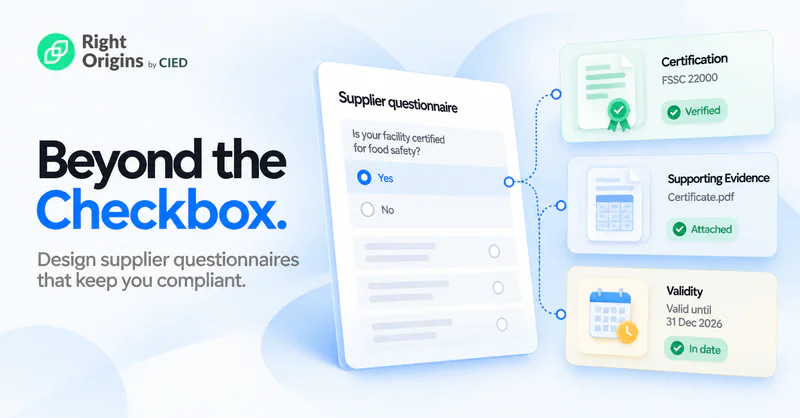
A supplier can complete every field in your questionnaire and still leave your compliance team with very little usable information.
A supplier can answer “yes” when asked whether it holds the required certification. But six months later, an audit or customer request arrives. Your team now needs to know which site the certification covered, when it expires and whether it applies to the product in question. And the email back and forth starts.
A good supplier questionnaire should do more than collect answers during supplier onboarding. It should help your team understand what the answer applies to, what evidence supports it, whether that evidence is still valid and what action needs to follow.
What is a supplier questionnaire?
A supplier questionnaire is a structured set of questions used to collect the information an organisation needs to evaluate, approve or monitor a supplier. Depending on the business and supplier, it can cover quality systems, regulatory requirements, certifications, food safety, manufacturing facilities, product information, packaging, sustainability and other areas of risk.
Ultimately, a compliance-ready supplier questionnaire should allow your team to answer four basic questions: what has the supplier confirmed, what does that confirmation apply to, what evidence supports it and can that information still be trusted today?
Why supplier questionnaires often fail compliance teams
Many questionnaires are designed around one objective: assessing whether the supplier fits the business. That is not the same as collecting information that can support a compliance decision.
To ensure your compliance, as well as your supplier’s, the questionnaire needs to be a lot more detailed. That requires a lot more email back-and-forth, a lot more time spent reviewing the details your supplier sends, and a lot more time spent on the clarification loop.
And all of this does happen, but not at the time of supplier onboarding. For that, you choose the easier way: “let’s just make sure the supplier is compliant. We’ll get into the proof details when the time comes.” Because, of course, as a quality and compliance professional, you already have a lot going on.
So, when the time comes, that simple supplier questionnaire opens doors for more complexities than you anticipated, which includes data gaps, outdated information, compliance risk, etc.
Scope creates another problem. An answer given at company level may only apply to one facility. A declaration might cover one material rather than every component supplied. Unless the supplier assessment questionnaire captures that scope explicitly, your supplier can unintentionally apply information more broadly than intended.
Finally, supplier information has a lifecycle. Certificates expire. Specifications change. Test results are replaced. Manufacturing locations change. A supplier assurance questionnaire that was accurate at onboarding can gradually become unreliable if there is no mechanism for identifying what needs to be reviewed.
What should a compliance-ready supplier questionnaire capture?
A useful way to structure a supplier questionnaire is around six information layers:
Requirement → Scope → Response → Evidence → Validity → Ownership
Together, these turn a standalone supplier response into information that can be assessed and reused.
1. Requirement
First, establish why the information is being requested.
The requirement might originate from regulation, a certification scheme, an internal specification, a customer requirement or another business standard. Connecting the question to the requirement helps reviewers understand why the answer matters and reduces unnecessary questions in the supplier assurance questionnaire.
2. Scope
Next, establish exactly what the answer covers.
Is it company-wide? Does it apply to one manufacturing site? One ingredient? A product family? A packaging material? A particular country or market?
Scope is especially important when building a questionnaire for suppliers operating multiple sites or supplying multiple product categories.
3. Response
Then determine what information the supplier actually needs to provide.
Where possible, collect structured information rather than relying exclusively on free-text answers. Dates, categories, certification numbers, locations, product identifiers and clearly defined options are much easier to review and compare than paragraphs of inconsistent text.
4. Evidence
For material compliance claims, identify what supports the response.
Evidence could include a certificate, specification, declaration, Certificate of Analysis, test report, audit report or another relevant document.
Importantly, evidence should be connected to the claim it supports rather than collected separately in an unstructured document folder.
5. Validity
Compliance information also needs a time dimension.
When was the document issued? When does it expire? When was the information last reviewed? Is there an effective date or version number?
Without this information, the supplier questionnaire provides a snapshot but gives the team no reliable way of knowing when that snapshot becomes outdated.
6. Ownership
Finally, capture who supplied the information and who is responsible for reviewing it internally.
That creates accountability when clarification, approval or an update is required.
Combined, these six layers make a supplier assessment questionnaire far more useful than a form containing disconnected yes/no questions.
Connect important answers to evidence
There is an important difference between an answer, evidence and verification.
Suppose your supplier questionnaire asks whether a supplier maintains a recognised food-safety certification.
The supplier answering “yes” is the response.
Providing the certificate is the evidence.
Checking that the certificate is current, covers the relevant site and has the correct scope is verification.
These should not be treated as the same thing.
That does not mean every question in a supplier assurance questionnaire requires an attachment.
Instead, ask for evidence where the response materially affects supplier approval, regulatory compliance, product suitability or another important decision.
Otherwise, a questionnaire for suppliers can quickly become a document-collection exercise in which files accumulate without a clear relationship to the claims they are supposed to support.
Design the supplier questionnaire for change
One of the biggest weaknesses in traditional supplier qualification is treating completion as the end of the process.
A supplier questionnaire completed today describes what was true when the supplier answered it.
However, information changes. New test reports replace old ones. And regulatory requirements continue to evolve.
Therefore, a supplier assessment questionnaire should capture more than the answer itself. Where relevant, it should also capture effective dates, expiry dates, review dates and document versions.
A supplier assurance questionnaire should also make it possible to identify which responses need attention when something changes rather than forcing the team to restart the entire assessment.
What should the supplier questionnaire workflow look like?
Designing a strong questionnaire is only one part of the process. Teams also need a consistent way to move responses from collection to approval.
A practical workflow looks like this:
Define requirement → determine supplier scope → send relevant questions → collect responses → collect supporting evidence → identify exceptions → request clarification → review and approve → monitor changes
The distinction between submitted and approved is particularly important.
A supplier may have completed every field in the questionnaire while still providing an expired certificate. A test report may cover the wrong material. An answer may contradict an existing specification. Supporting evidence may be missing entirely.
In other words:
Complete does not necessarily mean compliant.
That is why review and exception handling belong inside the supplier questionnaire workflow rather than being treated as administrative clean-up afterwards.
As supplier numbers grow, however, this is also where the workload increases. Teams need to know who has responded, which questions remain incomplete, what evidence is missing, which documents are expiring and which responses require internal review.
Automation can help here, not by deciding whether a supplier is compliant, but by removing much of the administrative work around collecting, organising, checking and following up on information.
For example, RightOrigins helps teams distribute supplier questionnaires, collect supplier information and supporting documents, identify missing information, automate follow-ups and keep supplier evidence centrally available for subsequent compliance workflows.
The assessment and compliance decision still belong with the responsible team.
Supplier questionnaire checklist: 10 questions to ask before sending it
Before releasing a new supplier assessment questionnaire, check whether it passes these ten tests:
Does every question support a genuine supplier, quality or compliance decision?
Is it clear which supplier, site, product or material each response covers?
Have vague yes/no questions been replaced where additional context is necessary?
Can important claims be connected to appropriate supporting evidence?
Are issue, expiry or review dates captured where relevant?
Can questions vary according to supplier type or risk?
Can missing, contradictory or incomplete information be identified?
Is someone internally responsible for reviewing important responses?
Can existing supplier information be updated without rebuilding the entire record?
Could the relevant answer and evidence be retrieved quickly during an audit, customer request or compliance assessment?
If the answer to several of these is no, the supplier assurance questionnaire may be collecting information without creating a reliable compliance record.
From collecting answers to maintaining compliance-ready supplier information
A thoughtfully designed supplier questionnaire gives compliance teams better information from the beginning. However, design alone does not solve the problem of maintaining that information across hundreds of suppliers, documents, products and requirements.
The next challenge is keeping the connections intact.
The supplier’s response needs to remain connected to the product or site it covers. The supporting evidence needs to remain connected to the claim. Expired information needs to be visible. Missing information needs to trigger follow-up. Existing evidence should be reusable when the same information is required elsewhere.
This is where moving from isolated forms and spreadsheets towards structured supplier information becomes valuable.
At RightOrigins, this is the part we focus on: reducing the administrative burden around collecting and maintaining supplier and compliance information so quality and compliance teams can spend more time reviewing risk and making decisions.