
A customer asks whether an ingredient contains a particular allergen. Your supplier declaration says it is “not intentionally added”. A previous questionnaire says “allergen-free”. Meanwhile, a newer specification includes a cross-contamination warning.
An AI tool can produce a response in seconds. But which information will it use, and will the answer preserve these important differences?
For food QA and compliance teams, questionnaire response accuracy depends on more than generating clear sentences. The answer must match the product, reflect current information and stay within what the evidence supports.
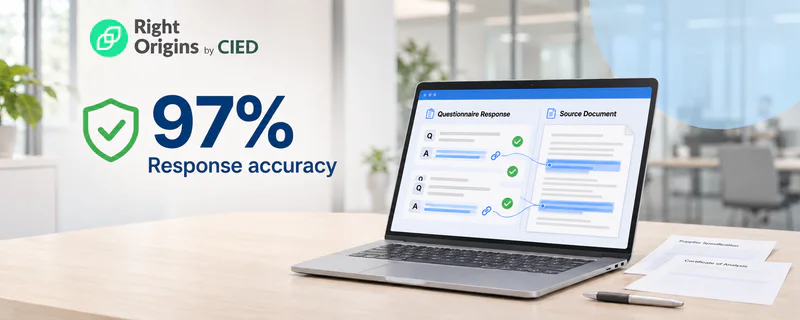
RightOrigins approaches this through a connected workflow: preparing company data, retrieving relevant evidence, applying response instructions, and keeping answers traceable. This approach has delivered over 97% response accuracy for RightOrigins' customers.
Here is how the process works.
Data cleaning and structuring is the first step
Questionnaire responses often draw on supplier declarations, product specifications, certificates, policies, and previous submissions. When these records are not updated and scattered across folders and systems, finding reliable information becomes difficult for people and AI alike.
RightOrigins first brings this information into a single source of truth.
Its digitisation process extracts useful information from documents and organises it into searchable records. These records are associated with details such as product, supplier, compliance topic, document version, and validity dates.
Validation is part of this preparation. Extracted information can be checked and approved before it becomes part of the knowledge used for answering.
This provides a stronger foundation for questionnaire automation. Instead of repeatedly searching an unorganised collection of files, the agent works with information that has structure, context and a clear source. To know more about how RightOrigins single source of truth works, read this deep-dive.
It retrieves information within the right context
A document can contain a correct statement and still be the wrong source for a particular question.
For example, a company may hold a certification covering one manufacturing site. That certificate does not automatically support the same answer for every product supplied by the company.
RightOrigins organises knowledge around products and entities, including suppliers and production sites. Product hierarchies, topics and tags help define which information is relevant to a questionnaire.
This structure helps the agent narrow its search before generating an answer. It reduces the risk of using a broadly similar record that belongs to a different product or organisation.
For QA teams managing many ingredients and suppliers, this distinction matters. Similar questions often require different answers because the underlying product or supplier context has changed.
It makes outdated and conflicting information visible
Using the latest available information is another essential part of response accuracy.
A previous questionnaire may contain an answer that was correct last year. However, the supplier, specification or certification behind it may have changed.
RightOrigins supports document version and validity controls, alongside checks for duplicate or conflicting information. Its documented workflow allows reviewers to investigate conflicts and decide whether to retain, archive or replace a record. Response instructions can also specify which document version should take priority.
Consider two specifications with different shelf-life values. Silently choosing one would leave the team unaware of the discrepancy. Making the conflict visible gives the team an opportunity to resolve it before the information reaches a customer.
These controls help maintain the quality of the knowledge base and responses as documents change.
It drafts responses from supporting company evidence
Once the relevant knowledge is available, RightOrigins' AI agent uses it to prepare the response.
This approach is commonly called retrieval-augmented generation: the system retrieves relevant information from a knowledge base and supplies it to the AI when generating an answer.
In RightOrigins, the documented workflow uses company records and configured instructions to guide this process. Instructions can reflect how the business handles particular questions, which sources it uses and what information it discloses.
The aim is to keep the answer aligned with the evidence. A supplier statement that an allergen is “not intentionally added”, for example, should retain that qualification rather than become a stronger claim that the product is allergen-free.
When supporting information cannot be found, the workflow is designed to return “no information available”. The team can then provide the missing document or add verified information.
Recognising an information gap is part of producing a reliable response.
It shows the evidence alongside the answer
Even a well-written response needs a clear connection to its source.
RightOrigins provides source references alongside generated answers, including supporting snippets and document details. Reviewers can inspect the relevant evidence without repeating the full document search.
This makes it easier to check whether the answer accurately reflects the source and whether an important condition has been omitted.
The QA professional can then approve or correct the response before it is returned in the customer’s questionnaire format.
Human approval provides a final control. It also preserves accountability for statements that may involve customer commitments, confidential information or specialist judgement.
Verified responses support future questionnaires
Many customer questionnaires revisit familiar topics with slightly different wording.
RightOrigins can store verified and edited responses as past answers for future matching. This gives the system additional company-approved knowledge to draw on when similar requests arrive.
Corrections therefore become useful beyond the questionnaire being reviewed. They can help improve consistency and reduce the need to resolve the same issue repeatedly.
However, reusable answers still depend on current supporting information. Maintaining the knowledge base remains important as products, suppliers and documentation change.
Building accuracy into the response process
In addition to saving time, RightOrigins supports accurate questionnaire responses through controls that work together: structured and validated information, relevant retrieval, document checks, evidence-based drafting and reusable verified knowledge.
Source visibility and human approval strengthen that process by making answers easier to investigate and confirm.
For QA teams, the practical value is less time spent reconstructing responses from scattered documents, with a clearer basis for the answers they submit.
Explore RightOrigins’ questionnaire response workflow and assess it using your own questionnaire and supporting documents.