
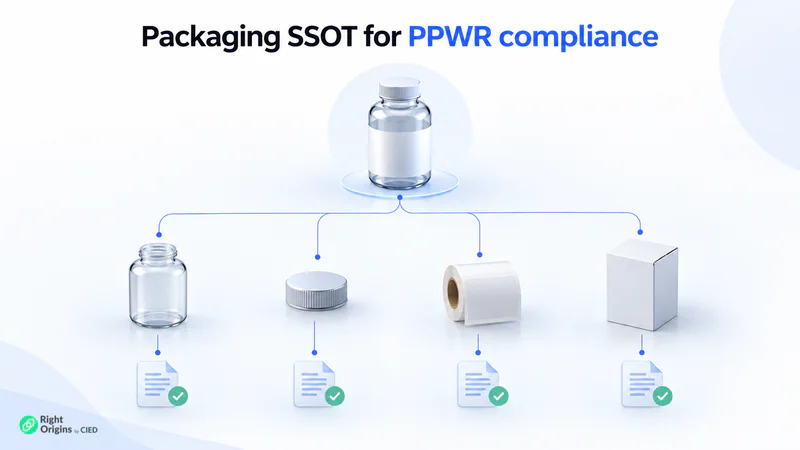
Under the Packaging and Packaging Waste Regulation (PPWR), the amount of information businesses need to collect, verify and maintain has grown considerably.
A single product may use primary packaging, labels, closures, sleeves, inserts and transport packaging from several suppliers. Each component can have its own material composition, weight, recycled-content value, test evidence and compliance documentation. When that information sits across spreadsheets, emails, supplier portals and shared drives, even a straightforward compliance question can turn into days of searching and follow-ups.
That’s why a packaging single source of truthhas become valuable. It gives quality, compliance, packaging, procurement and sustainability teams one governed place to find current packaging data and trace it back to the original evidence.
In this guide, we explain what a packaging single source of truth should contain, how to build one for PPWR compliance and how to keep it reliable as packaging and regulatory requirements change.
What is a packaging single source of truth?
A packaging single source of truth is a governed system that connects every product and packaging component with its approved specifications, material composition, weight, supplier, regulatory status, supporting evidence and version history.
Unlike a shared drive, it does not simply bring files into one location. It turns information contained in packaging specifications, declarations, certificates and test reports into structured, searchable data. Every important value should remain connected to its source so teams can see where the information came from, whether it has been approved and when it was last updated.
For PPWR compliance, this traceability matters. If a system records that a bottle contains 30% recycled plastic, for example, a reviewer should be able to open the supplier document supporting that value. If a new specification changes the percentage, the system should flag the change rather than silently replacing the previous record.
A packaging SSOT therefore combines structured data, supporting evidence and governance. All three are needed before teams can treat the information as reliable.
Why PPWR creates a packaging data challenge
Regulation (EU) 2025/40 applies to packaging regardless of its material or origin and covers its full lifecycle. It introduces requirements relating to packaging minimisation, recyclability, recycled plastic content, substances of concern, labelling, reuse and extended producer responsibility.
The European Commission explains that the regulation covers packaging design, composition, recycled material, waste prevention, reuse, collection and recycling.
For businesses, these requirements translate into a detailed data burden.
A packaging minimisation assessment requires accurate weight and dimension information. Recycled-content claims need material-level data and appropriate supplier evidence. Substance restrictions may require declarations or test results. Recyclability assessments depend on understanding every relevant component and material layer, rather than recording the finished pack as a single object.
The information must also remain current. A compliant assessment based on an obsolete specification may provide false confidence. Consequently, PPWR packaging data needs to be connected, source-traceable and governed throughout the life of the packaging.
What information should a packaging SSOT contain?
The exact data model will depend on the products, packaging formats and economic operator roles of the business. Nevertheless, an effective packaging single source of truth will usually contain several core groups of information.
These fields should not exist as unrelated rows in a spreadsheet. A unified packaging data system must preserve the relationships between them.
For example, one finished product might have four packaging components. A bottle may also be used across several other SKUs, while the transport case may come from another supplier and contain different recycled-content evidence. The data system needs to reflect these many-to-many relationships without duplicating or disconnecting the underlying information.
How to create a packaging single source of truth
Building a packaging single source of truth is not simply an exercise in migrating files. The aim is to create a dependable operating model for collecting, reviewing, using and updating packaging information.
1. Define the packaging hierarchy
Start by deciding how the system will represent packaging.
At the highest level, you may have a finished product or SKU. Beneath it sit the packaging units and individual components, such as a bottle, cap, label, carton or pallet wrap. Some components then need to be divided into separate material layers.
This hierarchy matters because PPWR assessments often require more detail than a product-level description can provide. Recording a component as a “plastic pouch” may not reveal that it contains several polymers, a barrier layer, ink and an adhesive. Those details can affect recyclability and substance assessments.
A clear hierarchy allows the packaging SSOT to show precisely which components and materials make up each packaged product.
2. Build a complete packaging inventory
Once the hierarchy is agreed, identify all the packaging the business places on the EU market.
The inventory should cover primary, grouped, transport, e-commerce and service packaging where relevant. It should also include packaging used for co-packed products, private-label lines, imported products and smaller markets.
The long tail deserves particular attention. Businesses often have good records for flagship products but weaker coverage for older SKUs, low-volume ranges or packaging sourced through distributors. These gaps may remain hidden when the inventory is organised only by broad product family.
At this stage, focus on completeness rather than perfect data. The first goal is to understand which packaging exists, which products use it and where the available information currently lives.
3. Establish the minimum data model
The next step is to define the minimum information needed for each packaging component.
This should include identification data, technical attributes, supplier details, applicable PPWR fields and evidence metadata. It should also specify accepted units, naming conventions and controlled values.
For instance, suppliers may express packaging weight in grams, kilograms or weight per thousand units. Material names may also vary between documents. Without standardisation, a unified packaging data system can still contain inconsistent information that is difficult to compare or aggregate.
However, avoid collecting fields simply because they might be useful one day. Every mandatory field should support a compliance assessment, operational workflow, reporting requirement or business decision. This keeps supplier requests manageable and makes ownership clearer.
4. Connect each value to its source
A credible packaging single source of truth should show more than the current value. It should also show the evidence behind that value.
If the system records material composition, recycled content or PFAS-related information, users should be able to trace the entry back to the relevant specification, declaration, certificate or test report. The record should include the source document, document owner, issue date, validity status and internal approval state.
This creates data provenance: a visible chain connecting a compliance claim to its source.
Without this connection, teams may know what the database says but still be unable to demonstrate why the information should be trusted. Source traceability is therefore one of the most important differences between an ordinary packaging database and a genuine packaging SSOT.
5. Standardise supplier data collection
A substantial proportion of PPWR packaging data originates outside the business. Packaging suppliers may hold the latest material specifications, recycled-content declarations, substance information and supporting certificates.
When every team requests this information differently, suppliers receive overlapping questions in inconsistent formats. Their responses then return through emails and attachments that someone must manually sort.
A structured collection process should ask each supplier for the fields and documents relevant to the component they provide. It should use consistent terminology and units, record the response against the correct component and highlight unanswered questions.
The process should also track whether documents remain valid. Receiving a certificate once does not mean the evidence will remain current indefinitely.
Standardisation makes the supplier experience clearer while giving internal teams a more reliable way to monitor missing PPWR packaging data.
6. Validate data and resolve conflicts
Centralising information will often reveal contradictions that were previously hidden.
One specification may record a tray weight of 14 grams, while a newer document states 16 grams. A supplier questionnaire may report a different recycled-content percentage from the supporting declaration. Two business units may even use different names for the same component.
A unified packaging data system needs rules for identifying and resolving these conflicts. It should retain the existing value, show the proposed change and allow an authorised owner to approve, reject or investigate it.
High-risk or disputed information should remain subject to human review. AI can help detect changes and inconsistencies, but it should not silently decide which regulatory evidence is correct.
This approval process protects the integrity of the packaging single source of truth and provides a visible history of how the final value was chosen.
7. Create update triggers
Packaging data begins to age as soon as the initial inventory is complete. Suppliers change, materials are substituted, certificates expire and products enter new markets.
For that reason, maintaining a packaging SSOT requires event-based controls. A revised specification, new supplier, material change, market launch or expiring document should trigger a review of the affected packaging record.
The system should also show the downstream impact of a change. If one closure is used across 30 products, a new material specification may require 30 product records or assessments to be reviewed. That relationship is difficult to manage when information is duplicated across separate spreadsheets.
Scheduled reviews can provide an additional safeguard, but they should not be the only control. A living packaging single source of truth responds whenever the packaging or its evidence changes.
Common mistakes when building a packaging SSOT
The most common mistake is treating file centralisation as data centralisation. Moving every packaging document into one folder may improve access, but users still have to open and interpret each file to find an answer.
Another mistake is recording packaging only at finished-product level. This hides shared components and makes it difficult to assess separate material layers. It also creates duplicated information that can fall out of sync.
Claims without evidence create a similar problem. A field may say that packaging is recyclable or contains a particular percentage of recycled material, but the team cannot confirm who provided the information or which document supports it.
Weak version control can cause further risk. When someone overwrites a value without retaining the previous record, reviewers lose the history needed to understand when the packaging changed and which products were affected.
Finally, some businesses build a new standalone database without considering their existing ERP, product information management or document systems. A packaging SSOT should connect relevant systems and govern the trusted record. It does not need to replace every application already in use.
Can a spreadsheet serve as a packaging single source of truth?
A spreadsheet can be a practical starting point for a small packaging portfolio. It can help teams define the packaging inventory, test the required fields and identify initial information gaps.
However, spreadsheets become difficult to govern when several products share components, evidence changes frequently or multiple teams edit the data. They also struggle to manage relationships between products, components, suppliers, material layers and documents without extensive duplication.
Version control is another challenge. Even when a spreadsheet shows the latest value, it may not clearly show the original source, approval history or downstream impact of a change.
Therefore, a spreadsheet may support the early discovery phase, but a growing or complex portfolio will usually need a more structured unified packaging data system.
How AI can help manage PPWR packaging data
Much of the information required for PPWR already exists inside specifications, declarations, certificates and test reports. The difficulty lies in extracting it consistently and connecting it to the correct product or component.
AI can help classify incoming documents, extract relevant fields and compare new files with approved versions. It can also highlight missing information, identify conflicting values and prepare follow-up requests for suppliers.
Once the information has been reviewed, AI can help map packaging evidence to the relevant assessment fields and answer questions across the approved knowledge base.
However, AI should preserve the connection between every extracted value and its source. It should also operate within approval rules defined by the business. Otherwise, automation can make unreliable data move faster without making it more trustworthy.
The purpose of AI in a packaging single source of truth is to reduce manual work while keeping evidence, context and human oversight intact.
How RightOrigins supports a packaging single source of truth
RightOrigins helps quality, compliance, packaging and sustainability teams turn fragmented PPWR packaging data into a structured, source-traceable system.
The platform can connect products with packaging units, components and material layers, while collecting relevant specifications and evidence from suppliers. AI extracts information from uploaded documents, organises it against the appropriate packaging record and flags missing or conflicting data for review.
Teams can then assess packaging against applicable PPWR requirements, track identified gaps and maintain the supporting information needed for a technical dossier. When a document or specification changes, the updated data remains connected to its source and review status.
This approach allows businesses to use the same packaging SSOT for supplier collaboration, compliance assessments, documentation workflows and future packaging decisions without turning the implementation into a separate manual exercise for each requirement.
Building a reliable foundation for PPWR compliance
PPWR compliance cannot be managed reliably when packaging information remains fragmented across teams, suppliers and documents. Businesses need a connected view of what each packaged product contains, which requirements apply and what evidence supports the assessment.
Creating that foundation takes more than moving files into a central folder. It requires a clear packaging hierarchy, structured data, source traceability, supplier coordination, approval controls and an ongoing process for managing change.
A well-maintained packaging single source of truth brings these elements together. It helps teams identify gaps earlier, respond to compliance questions with evidence and adapt as packaging designs and PPWR requirements evolve.
Most importantly, it gives the organisation a dependable data foundation for the compliance work ahead, rather than another static record that begins ageing as soon as it is completed.
Want to see how RightOrigins can help you structure PPWR packaging data, collaborate with suppliers and maintain an audit-ready packaging record? Explore the RightOrigins PPWR Compliance Platform.